

Music Beyond Genre - Pete Rainey
29 Apr 2026
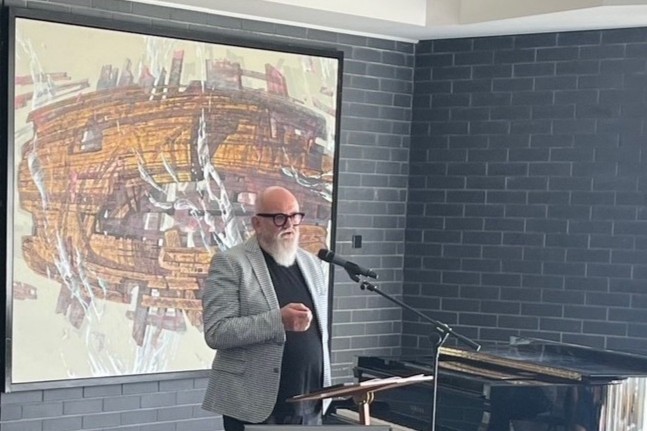
In a recent address to the Institute of Registered Music Teachers Conference at the Nelson Centre of Musical Arts, NZCF Chair Pete Rainey reflected on a lifetime spent moving between three very different musical worlds: choral music, youth contemporary music through Smokefreerockquest, and large-scale public performance through Nelson Opera in the Park.
His central message was simple but powerful:
music isn’t divided into genres — we divide it.
Pete spoke of his formative experience as a member of the 1982 National Youth Choir, touring internationally under Peter Godfrey and Guy Jansen, and of the lasting impact of that culture of excellence.
He connected this to NZCF’s current advocacy work, and outlined his personal ambition to see weekly singing become a normal and expected part of every primary school classroom in Aotearoa New Zealand.
He then traced the development of Smokefreerockquest, from its beginnings as a Christchurch event in 1988 to a national platform involving thousands of young performers, hundreds of schools, and more than 80 events annually. Alongside this, he reflected on 27 years as Artistic Director of Nelson Opera in the Park, where opera, orchestral music, popular music and large-scale civic celebration have regularly shared the same stage.
Across these experiences, Pete argued that the underlying musical behaviours are remarkably similar. A choir rehearsal may involve notation, blend, tuning and ensemble discipline; a Rockquest band may rely on groove, instinct, eye contact and energy. But at the heart of both are the same core skills: listening, adjusting, responding, collaborating and connecting.
He challenged the assumption that trained, notation-based music and instinctive, contemporary or improvised music belong to entirely separate worlds. Many outstanding young singers and contemporary musicians, he noted, learn through repetition, modelling, rehearsal, memory and digital resources rather than traditional notation. This does not diminish the musical result. Rather, it reminds educators that literacy is hugely valuable — but it is not the only pathway to real musicianship.
For teachers, Pete suggested the key question is not which genre is superior, but what musical capacities we are trying to grow. Timing, memory, confidence, expression, responsiveness and collaboration are transferable assets. They move across styles, traditions and settings.
He also noted that young musicians already live this reality. They move easily between choir, musical theatre, hip hop, folk, film music, waiata, classical repertoire and original songs, often without feeling any contradiction. The contradiction, he suggested, is often in the system rather than in the students.
Pete concluded by urging music educators and organisations to think less about defending genre boundaries and more about nurturing musicianship that is transferable. Genre remains useful, but it is not where music truly lives. Music lives in listening, imagination, shared attention and collaboration — and increasingly, that is where the future of music is being made.